


The modulus of elasticity, also known as Young's modulus, is a fundamental concept in materials science and engineering. It measures the stiffness of a material, indicating how much it will deform under a given amount of stress. In the context of loader bucket teeth, understanding the modulus of elasticity is crucial for ensuring optimal performance, durability, and safety. As a supplier of high - quality loader bucket teeth, I am often asked about this property and its significance.
Understanding the Modulus of Elasticity
The modulus of elasticity (E) is defined as the ratio of stress (σ) to strain (ε) within the elastic range of a material. Mathematically, it is expressed as (E=\frac{\sigma}{\varepsilon}). Stress is the force applied per unit area ((\sigma=\frac{F}{A}), where (F) is the force and (A) is the cross - sectional area), and strain is the relative deformation of the material ((\varepsilon=\frac{\Delta L}{L_0}), where (\Delta L) is the change in length and (L_0) is the original length).
A high modulus of elasticity means that a material is stiff and will deform less under a given stress. Conversely, a low modulus of elasticity indicates that the material is more flexible and will undergo greater deformation. For loader bucket teeth, which are subjected to high - impact forces during digging, scooping, and loading operations, a high modulus of elasticity is generally desirable.
Importance of Modulus of Elasticity for Loader Bucket Teeth
- Resistance to Deformation: Loader bucket teeth are constantly in contact with hard materials such as rocks, gravel, and soil. A high - modulus material can better withstand the forces exerted during these operations without significant deformation. This ensures that the teeth maintain their shape and sharpness, improving the efficiency of the loader and reducing the need for frequent replacements.
- Energy Absorption: When the bucket teeth strike an object, the energy of the impact is dissipated within the material. A material with an appropriate modulus of elasticity can absorb and distribute this energy effectively, reducing the risk of fracture or failure. This is especially important in applications where the loader is operating in harsh environments with large and irregularly shaped objects.
- Compatibility with the Loader: The modulus of elasticity of the bucket teeth should be compatible with the overall design and performance of the loader. If the teeth are too stiff, they may transmit excessive forces to the loader's bucket and other components, leading to premature wear and damage. On the other hand, if the teeth are too flexible, they may not be able to perform the required digging and loading tasks efficiently.
Factors Affecting the Modulus of Elasticity of Loader Bucket Teeth
- Material Composition: The type of material used to manufacture the bucket teeth has a significant impact on its modulus of elasticity. Common materials for loader bucket teeth include high - strength steels, alloy steels, and tungsten carbide. High - strength steels typically have a modulus of elasticity in the range of 200 - 210 GPa, while tungsten carbide has a much higher modulus, around 500 - 700 GPa.
- Heat Treatment: Heat treatment processes such as quenching and tempering can alter the microstructure of the material, which in turn affects its modulus of elasticity. Proper heat treatment can increase the hardness and strength of the teeth while maintaining an appropriate level of stiffness.
- Manufacturing Process: The manufacturing process, such as forging or casting, can also influence the modulus of elasticity. Forged teeth generally have a more uniform microstructure and better mechanical properties compared to cast teeth, resulting in a more consistent modulus of elasticity.
Our Loader Bucket Teeth Offerings
As a leading supplier of loader bucket teeth, we offer a wide range of products designed to meet the diverse needs of our customers. Our bucket teeth are made from high - quality materials and undergo strict quality control measures to ensure optimal performance.
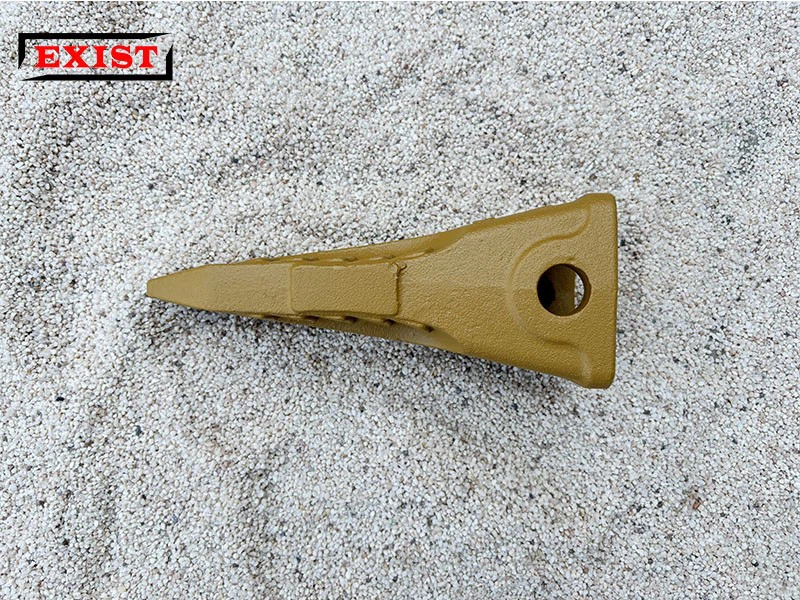
For example, our 1U3352RC Caterpillar Skid Steer Bucket Teeth Loader Bucket Teeth are specifically designed for Caterpillar skid steers. These teeth are made from a high - strength alloy steel with a carefully selected modulus of elasticity to provide excellent resistance to deformation and wear.
Another popular product is our 220 - 9133 Tooth Bar Shanks Tooth Bar Teeth Tooth Bucket For Skid Steer. These teeth are suitable for a variety of skid - steer applications and are engineered to withstand high - impact forces. The material used in these teeth has been optimized to balance stiffness and toughness, ensuring long - term durability.
We also offer 1U3252RC Tractor Bucket Teeth Cat Bucket Tip Excavator Teeth, which are ideal for tractors and excavators. These teeth are manufactured using advanced forging techniques to achieve a uniform microstructure and a consistent modulus of elasticity, resulting in reliable performance in demanding conditions.
How to Select the Right Loader Bucket Teeth Based on Modulus of Elasticity
- Understand the Application: Consider the type of material the loader will be working with (e.g., soft soil, hard rock) and the frequency and intensity of the operations. For heavy - duty applications involving hard materials, teeth with a higher modulus of elasticity may be more suitable.
- Consult with Experts: Our team of experts is available to provide guidance on selecting the right bucket teeth based on your specific requirements. We can analyze your application and recommend the most appropriate material and design to ensure optimal performance.
- Test and Evaluate: In some cases, it may be beneficial to test different types of bucket teeth in your actual operating environment. This can help you determine which teeth offer the best combination of stiffness, durability, and performance.
Conclusion
The modulus of elasticity is a critical property for loader bucket teeth, influencing their resistance to deformation, energy absorption, and overall performance. As a supplier, we are committed to providing high - quality bucket teeth with carefully selected modulus of elasticity values to meet the diverse needs of our customers. Whether you are working in construction, mining, agriculture, or any other industry that requires loader equipment, our range of products can provide the reliability and efficiency you need.
If you are interested in learning more about our loader bucket teeth or would like to discuss your specific requirements, please feel free to contact us. We look forward to the opportunity to work with you and provide the best solutions for your loader operations.

References
- Callister, W. D., & Rethwisch, D. G. (2011). Materials Science and Engineering: An Introduction. Wiley.
- Ashby, M. F., & Jones, D. R. H. (2005). Engineering Materials 1: An Introduction to Properties, Applications, and Design. Butterworth - Heinemann.


